
Costa Brava, Spain. The shadows had all but engulfed the hallowed football pitch at Roses as dusk beckoned. First half, minute nineteen, play resumed at the right flank as the ball was thrown in. After a quick exchange of passes, the ball made its way to a certain number 19 in blue, who had positioned himself ten yards outside the penalty box. Having given himself ample space, the boy took a touch and unleashed an absolute thunderbolt with his left foot. The ball was past the leaping goalkeeper before he could fathom what was coming at him. Two-nil.
From the description of the events above, the image of Lamine Yamal from his La Masia days might spring to the minds of the average football following individual. Number 19 at the back, football shirt with a shade of blue, left-footed strike from outside the box… except, the goal-scorer in this case was not Lamine Yamal. In fact, neither the footballer nor the team he was playing for had anything to do with Europe.
This was Konthoujam Chetan Singh, from India. The blue shirt he had on represented Minerva Academy Football Club, based in Mohali, and their opponent on the day was F.C. Boca Orange County, from California.
The final score on the day read 4-1 to Minerva Academy Football Club, courtesy of a brace from Konthoujam, who also scored the third goal, and goals from Chetan Tiwari and Azam Khan. Ranjit Bajaj’s boys in blue had well and truly marked their arrival in the 2026 Mediterranean International Cup, a global youth football tournament laced with legacy and graced by the biggest names in football over the years.
Read also: Top 10 La Masia Graduates who ruled football
A deep dive into Minerva Academy Football Club’s journey over the years
The beginning

Ranjit Bajaj has donned many hats over the years. Entrepreneur is the first word that comes up upon searching him on Google. In his own words, he managed the Indian Men’s Cricket team for seven Tests and 21 ODIs. He was also appointed the manager of Pakistan’s Men’s Cricket team for the Champions Trophy by the ICC. He is currently an AFC-certified football coach. His Twitter bio reads the following: Owner- Minerva Punjab FC/CC, Minerva Academy (Estd. 1955), Ex-India U19 Footballer, Roadies S1, Mountaineer, Animal Activist, Asian Record Holder, Motivator.
Motivator. That is the word the people of India are currently resonating with him the most. Ranjit Bajaj likes to refer to himself as a chief-pusher, and for good reason. His speech before Minerva Academy’s game against Liverpool F.C. in the MIC Cup spread like wildfire across all of social media after Bajaj’s boys completed a 6-0 drubbing over the English giants.
And this isn’t just a one-off – Ranjit Bajaj has been best known to turn his disciples into warriors with his words, or in some cases, actions. Take the example of the time Minerva Punjab F.C. travelled to Kolkata to play Mohun Bagan at the Vivekananda Yuva Bharati Krirangan in the 2017/18 I-League.
Minerva Punjab players celebrate a goal against Mohun Bagan. Image | Sportstar
2017/18 was Minerva Punjab F.C.’s second season in India’s top-flight football league.
The away game against Mohun Bagan that season was the first time they were playing at the Salt Lake Stadium, in front of a crowd famous for their passion and hostility. Naturally, the atmosphere in the Minerva Punjab F.C. dressing room was nervous before the game, and so, Bajaj had to perform a unique act to propel his men into a state of belligerence.
“I made the team physio draw a quart of blood so I could bathe the players in it,” Bajaj later said in an exclusive interview with Hindustan Times. He lined the players up, smearing palms of blood on each of their foreheads like a tika. Needless to say, it worked wonders.
“They actually transformed into warriors,” said Bajaj. “They spontaneously started thumping their chests and roaring out war-cries!”
Chencho Gyeltshen scored twice in the first thirty minutes for Minerva Punjab F.C. that day. While Kingsley Eze pulled one back for the hosts deep into injury time, Ranjit Bajaj’s men pulled off the unthinkable that day, beating Mohun Bagan 2 goals to one at their own den.
“That day we won more than just that match; we won the confidence to win the entire season,” Bajaj said.
And so they did. In only their second season in top-flight Indian football, Minerva Punjab F.C. lifted the I-League.

Minerva Academy was established in 1955 by Col. Deol – Ranjit Bajaj’s grandfather, primarily as a military training academy that coaches aspirants for the country's defence services exams.
Over 20,000 students – including those from the academy have joined the armed forces, 4,000 of whom are students of Ranjit Bajaj himself. The academy has been running cricket academies and teams since its inception as well, winning the All-India JP Atray Memorial Trophy in 2005 and 2025, and has produced international cricketers in Gurkeerat Singh Mann, Barinder Sran, Mandeep Singh, Rishi Dhawan, Siddharth Kaul, and most prominently, Shubman Gill, who has played close to 100 matches for Minerva.
Minerva’s footballing prowess began in 2005, with their contingent sending teams for local six-a-side tournaments. By 2013, the team was good enough for national tournaments of such kind, and so, that brought along the decision to field a team in the top-flight national leagues.
The road was far from easy, with the AIFF’s rules and regulations requiring state champions to qualify for the second division.
Thanks to Bajaj’s determination, a state tournament was held, two teams from the Minerva Academy met each other in the final, and in 2015/16, Minerva Academy rebranded itself as Minerva Punjab F.C. and made its way into the second tier of the national league.
In 2020, Roundglass purchased Punjab F.C., following which Minerva Academy was rechristened Minerva Academy F.C. again.
Read also: 10 Indian athletes who could have won the Bharat Ratna
The preparation
The human body has a substance called Myelin, an insulating sheath that forms around nerves, which is responsible for muscle memory. Myelin is produced for the fascia, which, in turn, is responsible for our decision-making. Therefore, the earlier a footballer starts their career, the better muscle memory they develop. To master the technical aspects of the sport, an emerging footballer needs a total of 10,000 hours of training to improve on a technical front in the sport.
Keeping all the above in mind, Minerva Academy sets a regimen for its disciples. The Academy accommodates and commences training for footballers as young as six years of age, a feat uniquely held by them. The Minervan students under scholarship undergo 240 hours of football training in a week, which amounts to 1,000 hours in a month and 10,000 hours in a year, with a two-month break.
Minerva Academy has produced state-of-the-art facilities for its disciples. Across the 13-acre land on which the academy is situated, there are four FIFA-approved football fields – two each for 11-a-side and nine-a-side contests. The academy also has a 5,000 square-foot indoor gym, a rehabilitation centre, a hydrotherapy pool, 18 classrooms for the kids to study, an auditorium, dressing rooms, and a mess for the footballers.
Over 150 staff members – sports psychologists, nutritionists, massage therapists, and, of course, football coaches – look after the protégés.
The A-licensed coaches work with the youngest boys to set them up for competitive football by the age of 14. As a result of their regime, the Minervan footballers ace their fitness tests. VO2 max is above 20 for all the footballers at the early teenage levels. Body fat percentage is between eight and nine per cent.
Despite playing three to four football matches a day in the tournaments they’ve been taking part in, major injuries are minimal in number. This is partly down to their pre-match preparation – the footballers are fed shots of turmeric and gherkin juice to avoid cramp. They emphasise stretching, consume carbohydrates and undergo a hydration test before every game, which helps them remain supple and avoid bruises after being hit.
Read also: 5 memorable performances by Indian football teams in Asian competitions
The football
Ranjit Bajaj prefers a 4-3-3 formation as opposed to a 4-2-3-1, given the flexibility of two attacking midfielders in the half spaces. At Minerva Academy, defenders are made to pass out from the back from a very young age, which makes them comfortable on the ball and creates muscle memory. As per modern-day football’s requirements, Bajaj instructs his boys to play one-two touch passes instead of dribbling before reaching the final third area.
Bajaj also forbids his players from applying spin on a pass, for it can hinder the first touch of the receiver. He also recommends providing cut-backs from the flanks instead of crosses due to the 50-50 nature of the latter. According to him, the cut-back needs to be strong enough for the finisher to merely glance it towards the goal.
European teams tend to be technically ahead from a very young age. To compensate for that, Bajaj demands physical intensity from his disciples. He believes pressing from the front relentlessly leads to the opponent giving the ball away or making a bad pass. When in possession, if there’s a risky pass, Bajaj would urge his players to go for it, for even if they lose possession, there’s a good chance of counter-pressing, because the opponent will widen up upon having the ball.
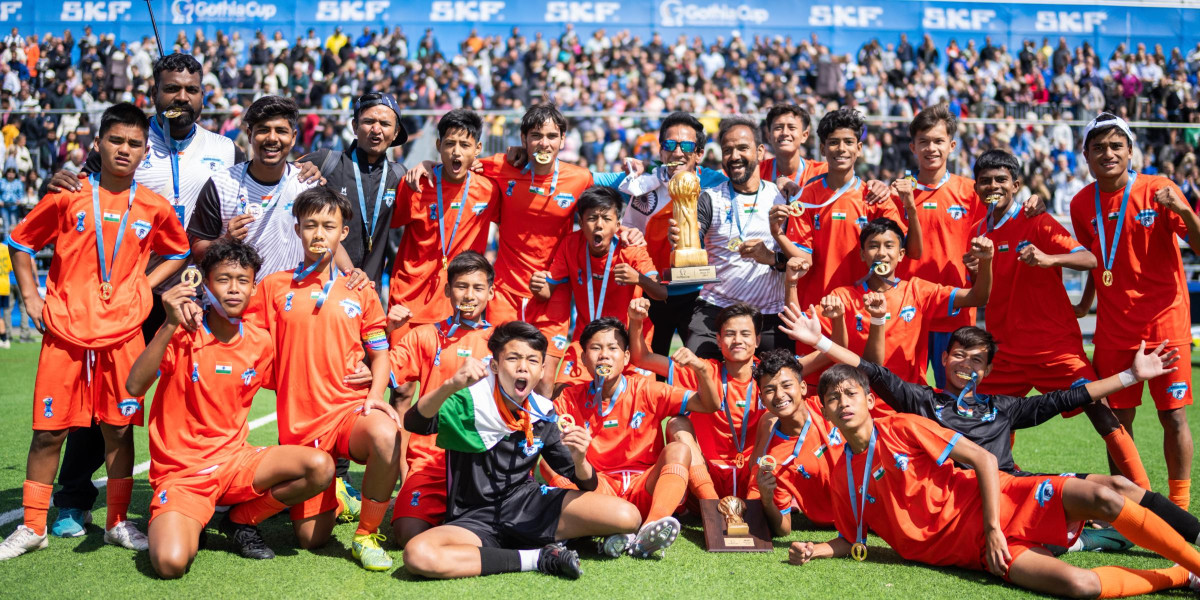
As a result of following the set routines and the tactics set by the main man, the accolades have come along rather emphatically for Ranjit Bajaj’s boys over the last three years. Champions of the U12 MINA Cup in 2022, champions of the U13 Gothia Cup – revered as the world youth cup – in 2023, and then in 2025, a treble for the U14 boys – the Gothia Cup again, the Dana Cup, the Norway Cup…all of these have been achieved by the same batch of boys.
The margins of wins in the finals of all these competitions were significant, to say the least.
Minerva Academy F.C. beat Argentine club CEF 18 Tucuman 4-0 in the 2025 Gothia Cup final, followed that up with a resounding 15-0 routing of Malta’s KFF Club in the U14 Dana Cup final a week later, and then went on to complete another demolition job, obliterating Sverresborg Football 14-1 to clinch the Norway Cup and becoming the first ever team to win all three youth football tournaments in the same year.
Minerva Academy F.C.’s 2026 MIC Cup campaign was a clear testament to all the hard work put in by the team members in the last three years. With the ball, the Minerva Colts were fluid – they were quick in transitional phases by playing one-two touches, didn’t stall, hardly played any sideways or back-passes other than on occasions of winning possession and regrouping.
The Minervans built up play from the back with immense composure, which led to goals against Santa Ana and Liverpool. Most times, owing to the breeze, they took their free kicks and corners indirectly, passing to spare players instead of shooting or crossing the first time. An example of the same was the first corner they took against F.C. Boca O.C. – a one-two followed by a cross.
Not too often are viewers more glued to a team when they do not have the ball as opposed to when they do, but Ranjit Bajaj’s boys must have been an exception. The number of instances the Minervans recovered the ball from the opponents’ set-pieces felt almost astonishing – akin to a routine, which has also led to goals on a few occasions.
Whenever the Minervan boys lost possession due to an error, their hunger to win it back amplified. As per the instructions from the coaching staff, the Minerva frontline pressed their opponents so hard that, more often than not, the opponents failed to play out the back, go long, and lose possession as a result.
The scorelines spoke for themselves. A 4-1 win over F.C. Boca Orange County to start their campaign. 3-0 and 1-0 wins over Kaptiva Sports Academy and EF Santa Ana, respectively, on the same day. A 3-0 win over Canada’s CS Braves Ahuntsic followed, setting up a round of 16 clash against Liverpool’s U15 contingent.
“Thokna hai” (Smash them) was the crux of Ranjit Bajaj’s team talk ahead of the much-anticipated clash with the English giants, and the boys in blue duly obliged. Having received the ball from goalkeeper Daksh Panwar, Azam Khan played a one-two pass, dashed down the left flank and put Minerva Academy F.C. ahead two minutes in.
Liverpool had a bit of control after the goal, but the incessant pressing from their opponents prevented them from breaking lines altogether. Raj Singh Wahengbam scored twice to put Minerva Academy F.C. 3-0 up going into half-time, the ball being stolen from Liverpool’s own half on both occasions.
Liverpool never really recovered from that first half. Raj completed his hat-trick, Azam Khan scored a second, and Lisham Amarson Singh added to the tally. The scoreline read Liverpool 0-6 Minerva Academy F.C. at the end of 50 minutes. That 6 beside Minerva’s name could have been a lot more; in fact, Ranjit Bajaj’s boys had 11 shots on target and accumulated an XG of 5.63.
It took a dodgy penalty call from the referee in the dying minutes of the quarter-final against U.E. Figueres for the MIC Cup campaign to end for Minerva Academy F.C. – they had to bow out after a heartbreaking 2-1 defeat. But by then, the impact was made. The academy now has the attention of a good chunk of the football-watching population of India.
Beyond all this, there has been one prominent trait across the Minerva Academy F.C. contingent all these years – HUNGER. The hunger to conquer, the hunger to prevail, the hunger to succeed, the hunger to make a telling statement all over the football world – this is who we are. This is what we can do for the country. This is the blueprint with which we are capable of triumphing over the best of the best at our level.
The only issue? The personnel at Minerva Academy F.C. would have remained famished… had their director’s constant pleas for financial assistance not been answered by the people of India.
The struggle
In 2025, the entire tour to Scandinavia for the youth football championships cost Ranjit Bajaj a total of 3.5 crores, which he had to pay out of his own pocket. Therefore, when the invitation to play in the MIC Cup came, the Minerva contingent was ecstatic, but there were fresh concerns over managing finances for the entire trip.
As per their calculation, the entire 22-day program for the tournament was Rs. 1 crore. The cost for the registration and accommodation for each player was around 1,000 Euros – roughly around Rs. 1 lakh – and then there were the costs of flight tickets and arrangements for travelling from one venue to the other during the trip. While Minerva Academy F.C. did enter into a partnership with a microgreens brand ahead of the MIC Cup, the means of the sponsorship was all in kind – the brand provided the players with their own products, and as it turned out, the microgreens enhanced the players’ performances.
In spite of all the silverware over the last three years, no corporate entity or football federation stepped up to offer financial support for the trip.
Eventually, Bajaj had to take a loan, mortgaging his own property in the process to fulfil the financial aspect of the trip to begin with. He then turned to the people he had the most trust in – the fans of the sport, appealed to raise funds for the 30 players and support staff going on the trip, and the response has been overwhelming, to say the least.
By the time the team began their tournament at Costa Brava, the amount of Rs. 1 crore had been raised by over 10,000 supporters of the organisation. Having received the financial boost that they required, the Minervan contingent sure did not disappoint.
Over 250 boys are on a 100 per cent scholarship at the academy. The approximate net spend on them has been around 8 crore – including their nutrition, accommodation, and education too, so that even if they do not make it as a footballer, they get to complete their education thanks to the academy, and can pursue higher studies. These boys have been selected from a total of 4,50,000 boys from all over India, across 18 states, ranging in age from 7 to 17.
The financial aspect of running such a state-of-the-art academy has always been an uphill task, but Minerva Academy’s hierarchy has had temporary solutions to such issues.
In 2020, Gurpreet ‘Sunny’ Singh, owner of Roundglass, a company dedicated to holistic wellbeing, took over Punjab F.C. from Minerva for Rs. 15 crore, taking the age-group teams, the senior team, and the slot to play the I-League in the process. Ranjit Bajaj earned another Rs. 5 crore to run the team for the first year, which pumped some funding into the academy to begin with.
Minerva Academy also have a paid programme for the students who are not selected for the age-group football teams, but are still willing to fight for a spot in it and train the same way as the first teams. Some of the funding for the teams at age-group levels – approximately between 4.5-5 crore rupees – has come from this programme.
But all of those modes of funding are short-term fixes. The academy needs financial support every year, for the new batches of footballers – the former U10, U11 players who will be playing the following editions of all the football tournaments the academy has done well. The more clubs and organisations step forward to take care of the current batch of players aged under 18, the more chances there are of the academy bringing new budding footballers in and grooming them into champions.
The future
“My life’s only aim is to help India reach the World Cup. I am going to do it – 90 per cent is manifestation. If I don’t believe it, how will my boys and my country believe? I’m not going to leave it, I’m going to get us there, or I’ll die trying.”
Ranjit Bajaj’s resolve is strong and carries a strong assurance, more so now. He sure is making progress with his boys, and the reactions and growing perceptions regarding the academy outside India suggest so.
Despite conceding defeat to PK-35 in the Helsinki Cup final in 2025, Minerva Academy F.C. were lauded for their brand of football. The coach of PK-35 was mightily impressed with Minerva Academy F.C.’s press, and told Bajaj after the final that, for the first time in 40 years, his team played a low block, couldn’t get out of the press, and had to rely on long balls to score.
The coaching staff at McCarty F.C., a team from the Philippines, who have been participating in the Gothia Cup in Sweden for 42 years, had the opinion that they hadn’t seen a team play like this at this level before. The Indian embassy in Norway called the academy to felicitate them – they were told by the locals that they had never seen a team play like this in the history of the Norway Cup, spanning over 50 years and among the one million participants.
Renowned football journalist Fabrizio Romano took to Instagram to confirm Minerva Academy F.C.’s participation in the MIC Cup, which also aided the academy in raising funds.
Based on their success in 2025, Ranjit Bajaj mentioned that the academy had received interest from a scout based in the Netherlands – an individual who had scouted for Ajax before. Before their departure for the MIC Cup, Bajaj was told that the scout would travel to Spain from the Netherlands to scout six of their boys.
Given the performances of the likes of Raj Singh Wahengbam, Tony Huidrom, Azam Khan, Konthoujam Chetan Singh and many more in the MIC Cup, one can be hopeful about the prospects of these boys being picked up by European teams once they turn 16.
Over 250 international footballers across age groups and senior teams have been produced by Minerva Academy in the last ten years. That’s more than the total number of footballers produced by all the football clubs and academies in India in the same time span, something that causes Bajaj displeasure – youth development has been on the back pages for 90 per cent of Indian football’s entities.
So, how does Ranjit Bajaj aim to help India reach the FIFA World Cup?
In a podcast with Simarpreet Singh, he says, “My goal is to make so many players good enough to play in the European leagues in future, that the national selectors are compelled to pick them for the Indian football team. If they pick them, India will qualify for the World Cup.
It’s like a chain – the seniors will do well once the age-group teams do well across the years. Grassroots development comes first – take Uzbekistan for example – they succeeded at the U23, U19 levels and have qualified for the World Cup.”
Possibly, for the first time, a footballing academy from India has garnered this much attention from the people of the country. Currently, Minerva Academy is a hot topic among the football-watching influencers on social media, and for the right reasons.
The road ahead is quite long, rocky terrains might come along the way, but given the transparency offered by Bajaj and the promise shown by the warrior-like Minervan boys throughout their journey in Europe, the long-time supporters of Indian football suddenly see promise for a transformative leap for India in the sport.


![East Bengal FC Trophies List [Men's & Women's] | Updated](/_next/image?url=https%3A%2F%2Fpub-fc6b0668ad0242ec8180d92255407043.r2.dev%2Fsportzpoint%2F1779385369364-east-bengal-trophies-list.jpg&w=3840&q=75)

![East Bengal vs Mohun Bagan: Head to Head Stats [UPDATED]](/_next/image?url=https%3A%2F%2Fpub-fc6b0668ad0242ec8180d92255407043.r2.dev%2Fsportzpoint%2F1779083597619-east-bengal-vs-mohun-bagan.jpg&w=3840&q=75)