%2Fsportzpoint%2Fmedia_files%2F8447063e-41da-4eb3-9f7e-d7b25ecfa2a3.jpg&w=3840&q=75)
All India Football Federation (AIFF) President Kalyan Chaubey has again commented on the plan to integrate Indian-origin footballers into the Indian national football team.
Describing the move as a potential "game-changer" for Indian football, Cahaubey stated that the AIFF is "actively working" to explore the feasibility of this plan.
Kalyan Chaubey confirms efforts to bring Overseas Indian-Origin (OCA) players into Indian football 🇮🇳#allindiafootball #indianfootball pic.twitter.com/WtXosQuKYT
However, Chaubey first addressed this issue which dates back to 2023, when he stated that AIFF is "looking to approach" 24 PIO (Persons of Indian Origin) players, who could represent the national team. Although the AIFF chief did not reveal the players' names back then, there have been no updates regarding the approach as well.
Convincingly, Indian football fans have been fuming over these lackluster and aimless plans from AIFF which have not been materialized yet. This is why what Chaubey said to PTI on Thursday, has sparked further dissatisfaction among Indian football fans.
"Making efforts to create": Does AIFF actually have a plan?
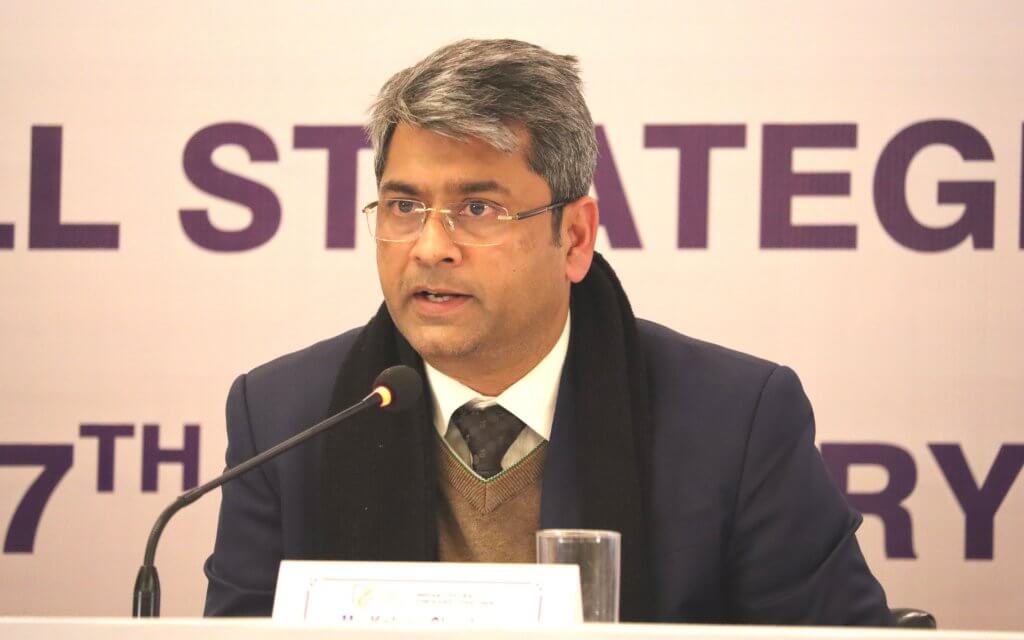
Speaking to PTI, Chaubey has stated the following on the sidelines of the Khelo India Para Games 2025 in New Delhi.
We are making efforts to create a policy framework that allows us to utilise the talent of overseas Indian-origin (OCA) players,
Many countries have already done this, and until we establish clear guidelines, our national team selection will continue to follow existing rules. However, we must recognise that integrating these players could be a game-changer for Indian football.
At present, we are depending on a single player like Sunil Chhetri in crucial moments. The question remains -- who will take his place? We need a long-term plan to develop Indian strikers, especially for the No. 9 and No. 10 positions.
Currently, most clubs prefer foreign strikers in these roles, which hampers the growth of Indian forwards. Our aim is to change that by creating better pathways for our players,
Chaubey's comments have not encouraged Indian football fans much, especially since the AIFF is still 'developing' a policy for OCA players.
In contrast, neighboring country Bangladesh has already landed midfielder Hamza Choudhary, who has represented England at the youth level and has played for Leicester City in the Premier League. He is currently on loan at Sheffield United, which competes in the EFL Championship.
Previous instances regarding the possibility of OCI and PIO players representing India

When Englishman Bob Houghton served as the head coach of the Indian national football team from 2006 to 2011, there were attempts to reach out to Michael Chopra.
Chopra had previously played for England's youth teams and for clubs such as Newcastle United and Nottingham Forest, to see if he would be interested in representing India.
Michael Chopra - for a while, this man was arguably the best striker in the championship, consistently bagging for Cardiff over 2 spells. Also spent time at both Newcastle and Sunderland, as well as Ipswich and Blackpool, but it was in South Wales where he made himself a hero pic.twitter.com/vAVW0YHcVd
— random footballers (@RandomEFLers) September 9, 2019
However, a government rule implemented in 2008 thrashed any hopes of including players of Indian origin (PIO) in the national squad. This rule stipulated that PIO and Overseas Citizen of India (OCI) cardholders must renounce their foreign citizenship and obtain Indian passports to be eligible to play for India.
Read Also | Top 10 Indian-origin footballers who could represent India, if OCI and PIO players were permitted
In 2020, Indian Origin player Aryn Williams, who played for NEROCA FC in 2017-19, shared his story on why he gave up the dreams of representing the Indian National Team. The midfielder, who represented Australia at senior levels, said the following.
That was my ultimate goal, to get an Indian passport and go to the national team, But when I arrived, it just proved to be an impossible task. I went through many agencies and companies but nobody really knew what to do. It was making me stressed so in the end I left it.
Ryan Williams, who currently plays for Bengaluru FC, has a twin brother, Aryn Williams, who featured for NEROCA FC in India between 2017 and 2019. Interestingly, their maternal grandfather, Linky Grostate, represented Bombay in the Santosh Trophy during the 1950s, highlighting a… pic.twitter.com/5kki9sivAe
— Adipoli Bro (@VinayakSha95237) March 22, 2025
Yan Dhanda, another Indian-origin footballer who previously played for Liverpool in the youth divisions and was also a part of the England U-17 team that won the UEFA U-17 EURO Championship in 2017; expressed his hopes to play for India as a dual citizen.
Dhanda wrote the following on X (Twitter) in response to the then-AIFF secretary-general Dr. Shaji Prabhakaran.
Giving up my passport means I can’t play professionally in the UK and some European clubs, due to India’s FIFA ranking. Permitting OCI cards, similar to other countries, will allow me to represent the Indian football team as a dual national. I hope this can happen soon
Giving up my passport means I can’t play professionally in the UK and some European clubs, due to India’s FIFA ranking. Permitting OCI cards, similar to other countries, will allow me to represent the Indian football team as a dual national. I hope this can happen soon 🙏🏽 https://t.co/YOfT5YmnIa
— Yan (@yandhanda) March 27, 2023
Back in August 2023, AIFF formulated a task force to conduct a feasibility study of allowing Persons of Indian Origin (PIO) and Overseas Citizens of India (OCI) to play in the country's national teams.

The task force, which was constituted by Kalyan Chaubey was supposed to explore and analyze the PIO and OCI footballers playing at a higher level and the status of the youth players of the same. It was chaired by Punjab Football Association president Samir Thapar.
“We will first form a comprehensive database on the OCI and PIO footballers around the world, and then look for the best possible ways to use such players to take Indian football forward."
— Marcus Mergulhao (@MarcusMergulhao) August 14, 2023
-- AIFF President Kalyan Chaubey
Chaubey said this in a press release:
The Task Force's primary objective will be to collect data on footballers who are either Overseas Citizens of India or Persons of Indian Origin. It is a matter of great pride for us that many such footballers are playing in different countries with distinction and have made a name for themselves in the tough world of professional football.
However, its report was supposed to be submitted by January 31, 2024. In December 2023, AIFF confirmed that they are approaching 24 PIO players soon. Chaubey told the following to PTI in an interview:
We are looking to approach 24 PIO players who are playing across the world. But you know there is the issue of dual citizenship (not being permitted to play for India). So, we have to see how this can be done within the framework of the Central Government’s rules,
We are having internal discussions on the matter and will come out with more details once more clarity is established.
Former Indian coach Igor Stimac had strongly advocated multiple times for the inclusion of OCI and PIO players into the national team. Post his sacking, Stimac summed up the situation via his comments. He stated:
India’s football is in prisons. No involvement of OCI players. Without PIO/OCI, football development in India is going to be difficult. It’ll take at least two decades to develop world-class players from India.
I’m not sure if there is any other country which is not allowing players of their origin to represent their country.”
It is a huge handicap because there are many good players of Indian origin playing in the top leagues of Europe. So it could be a big help if we speak about bigger achievements.
The Pathways for OCI Card Holders to represent India
(The following are extracted from an article by Legal World-Economic Times)
FIFA regulations state that a player must hold the passport of the country they represent. The Commentary on the Rules Governing Eligibility to Play for Representative Teams published by FIFA also mentions that:
"The only document considered to be valid proof of a player's identity and nationality shall be a permanent international passport that explicitly, and in Latin characters, states the player's full name, date of birth, place of birth and nationality".
Furthermore, the FIFA regulations for the World Cup 2022 state that "A player without a valid permanent international passport shall not be entitled to play."
A country's policy regarding dual or multiple citizenship is associated with its policy regarding eligibility criteria for athletes. Athletes representing a country that has dual or multiple citizenship are generally permitted to play on their teams and by their names. Australia, Brazil, France, the United States, the United Kingdom, and South Africa are some of the countries that embrace dual citizenship. An athlete has to forgo their existing nationality and seek naturalization in the nation they wish to represent in nations that do not accept dual nationality, such as India.
All those persons who were born in India or whose parents were born in India are entitled to Indian citizenship as per the provisions of the Indian Constitution. Other requirements of acquiring, determining, and withdrawing Indian citizenship are stated in the Citizenship Act of 1955. But dual citizenship is not allowed under the Citizenship Act of 1955.
As per Section 9 of the Citizenship Act, a person who has acquired citizenship of some other country cannot be a citizen of India unless he relinquishes his citizenship in that country by making a declaration in a proper format. In addition, no Indian national can acquire citizenship of any foreign nation freely, as stated by Article 9 of the Indian Constitution.
The Indian government takes a firm stance on citizenship restrictions, which prohibit dual citizenship. Unless there is a drastic change in policy, only Indian citizens would be eligible to represent the country in international tournaments. Regardless of ability, every OCI or PIO card holder is ineligible.
![East Bengal FC Trophies List [Men's & Women's] | Updated](/_next/image?url=https%3A%2F%2Fpub-fc6b0668ad0242ec8180d92255407043.r2.dev%2Fsportzpoint%2F1779385369364-east-bengal-trophies-list.jpg&w=3840&q=75)

![East Bengal vs Mohun Bagan: Head to Head Stats [UPDATED]](/_next/image?url=https%3A%2F%2Fpub-fc6b0668ad0242ec8180d92255407043.r2.dev%2Fsportzpoint%2F1779083597619-east-bengal-vs-mohun-bagan.jpg&w=3840&q=75)